Hapag-Lloyd推出独立亚洲至墨西哥航线,接入Gemini枢纽网络
Hapag’s standalone Asia-Mexico string adds another spoke to Gemini hub network
Hapag-Lloyd计划于2027年1月启动AMX亚洲至墨西哥航线,使用自有船舶按宁波、青岛、釜山、恩塞纳达、曼萨尼约、拉萨罗·卡德纳斯、宁波的航线运行。文章认为,Gemini与Maersk运营的枢纽和支线网络为AMX补足了货源与中转连接,使Hapag-Lloyd能够用约8,000 teu至9,000 teu的自营航线替代部分此前从MSC购买的舱位。

Photo: APMT Terminals Lazaro Cardenas
11 November 2026
Hapag-Lloyd has presented AMX, its new Asia–Mexico service, as standalone: its own ships; its own rotation of Ningbo-Qingdao-Busan-Ensenada-Manzanillo-Lázaro Cárdenas-Ningbo; launching in January 2027.
Standalone is the word the press release leans on, and it is the one worth questioning.
AMX is standalone the way a spoke is standalone – Hapag owns the vessels, but it can only fill an 8,000 teu ship on this run because the Gemini hub network it operates with Maersk gives the cargo somewhere to come from.
The question more important than what AMX actually is… is why Hapag can build it now and could not a few years ago.
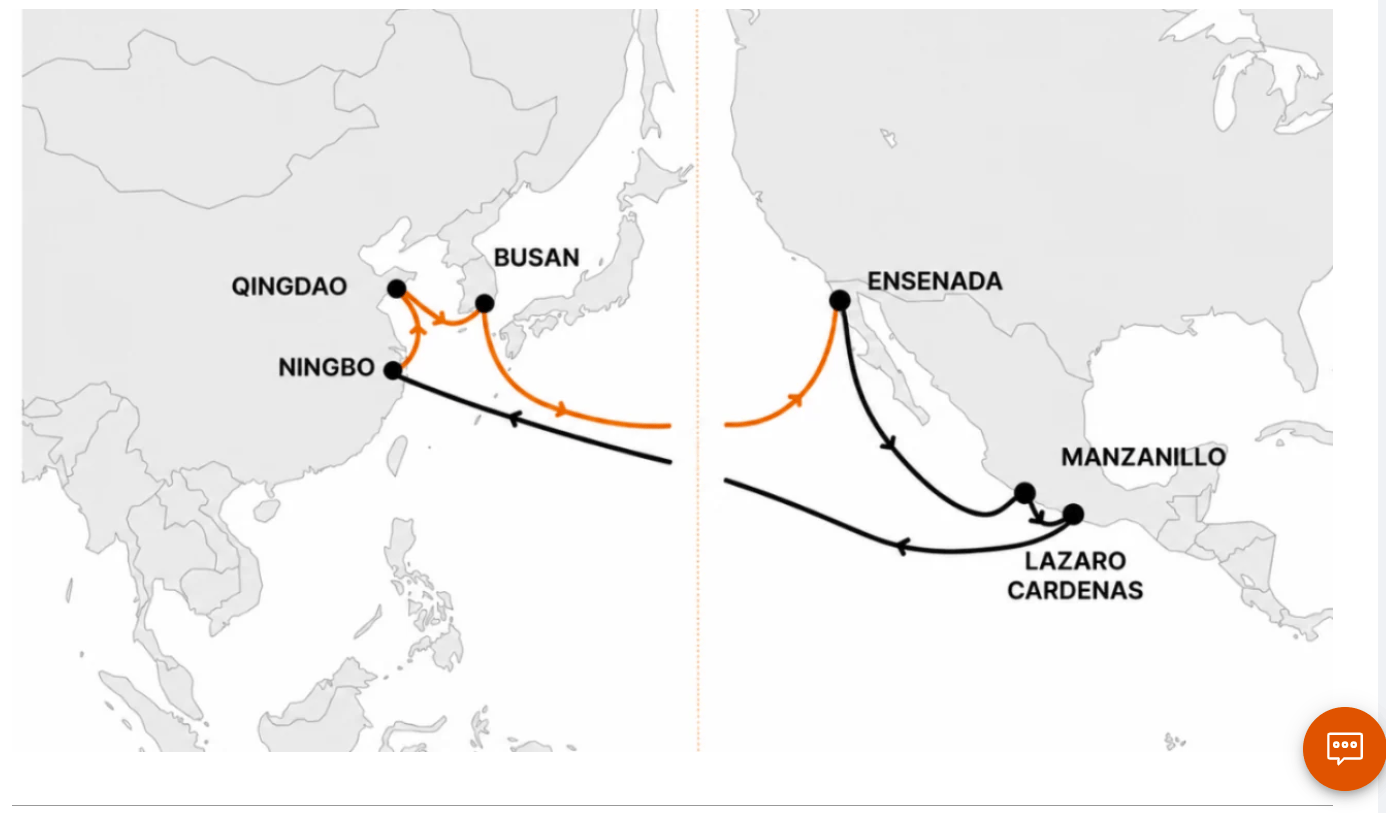
Source: Hapag-Lloyd
Why Hapag couldn’t do this before
Owning the ships was never the hard part. Making a standalone loop work was, and that is what Gemini changed. Hapag has the Mexico cargo — its customers’ boxes already fill thousands of slots a week — but that cargo has been riding other lines’ ships, and a self-operated 8,000 teu loop has to be kept full in both directions and plugged into ports Hapag does not call directly.
The hub-and-spoke network it now runs with Maersk supplies the missing pieces – balancing cargo through the Gemini hubs and relay connections onward, so AMX does not have to source a full, self-sufficient ship at Asian load ports.
That option did not exist in a usable form until Gemini bedded in over the course of 2026. The simple answer to ‘why standalone’ and ‘why 2027’ is that the network to support a self-controlled spoke only recently came together.
This is not a one-off design. Hapag’s new Asia-South America east coast loop, ASX, is built the same way – a north Asian anchor port at Qingdao; no Shanghai call; and a relay through a Gemini hub.
AMX repeats that pattern to on the Pacific. Neither reads as a line striking out alone. Each is an owned loop made to clip onto the Gemini backbone, and the method is consistent — control the vessel, fill it through the hubs.
The next move is MSC’s
On the Mexico trade Hapag has not been sitting in a consortium at all. It has run its book by buying slots, chiefly from MSC, the largest carrier into the country.
That slice is not small: I estimate Hapag’s allocation on MSC’s loops is worth around 8,375 teu of nominal vessel capacity, call it some 7,000 teu of usable space for its customers once a ship is realistically loaded. Line that up against AMX, sized at 8,000 teu-9,000 teu, and the service looks less like new capacity than like Hapag rebuilding its existing slot block on its own hulls. The point of AMX may not primarily be to carry more, but to stop renting space from a direct rival.
That raises the question of what MSC next does? The slot deal is MSC’s to continue or end, and a carrier that has just watched its slot customer launch a competing service has every reason to reclaim the space and fill it with its own fast-growing Mexico cargo.
If MSC terminates, Hapag loses the slots it was already replacing with AMX and ends up roughly where it is today on capacity, albeit independent of a competitor’s deck. If MSC keeps selling, Hapag briefly holds both.
Either way the move is the same: a line that was depending on the market leader for space is buying its way out of that dependence.
Mexico’s pull is not new
Neither the demand levels nor this kind of service are new. CMA CGM ran the same play in May 2024, launching M2X, its Mexico Express, to almost exactly the ports Hapag has now chosen – in fact, AMX’s rotation differs from M2X’s original by a single North China port. The pull is still there.
Chinese manufacturers have kept building in Mexico to serve the United States from inside the USMCA wall and to sell into Mexico itself, though the frantic investment of 2023–24 has since cooled, probably unsurprisingly.
Which means Hapag is – two and a half years later – responding to the signal CMA answered first with a near-identical loop, into ports that are already stretched.
The cautionary note sits in the same data: CMA CGM has lost more Mexican import share than any carrier over these years, even while running its own loop.
A ship of one’s own controls the cargo without guaranteeing you keep it.
来源:The Loadstar · theloadstar.com